
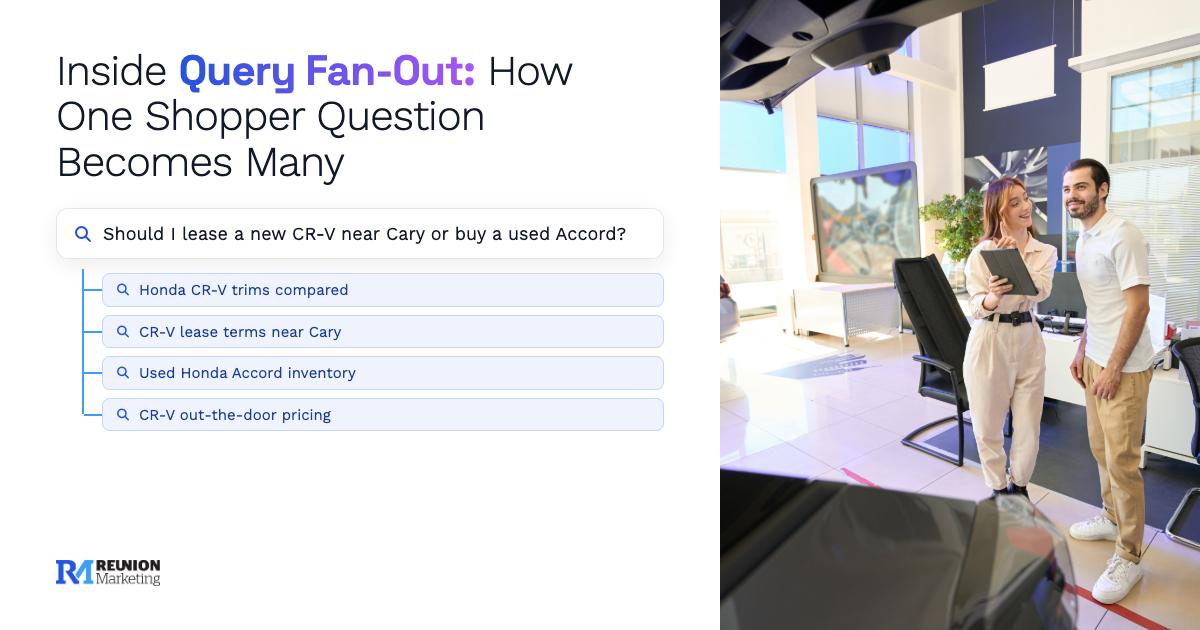
Query fan-out is how AI search turns one shopper question into many behind-the-scenes questions. Some of how this all works is confirmed, and some is still educated guessing. We’ve noted which is which, because the difference matters when someone is selling you a fix.
For what to ask your SEO provider about it, see our newsletter: Get Ready. The Next AI Pitch Is Coming.
One question in, many searches out
Before AI, a buyer typed “Should I lease a new CR-V near Cary or buy a used Accord?” into a search engine, which looked for pages matching those words. An AI search system treats the same question as a task: work out what information the answer needs, run a set of searches to collect it, and write one response from what comes back. That middle step is query fan-out.
How it works
- Interpret. An LLM reads the question and any conversation context.
- Expand. The model generates sub-queries, including topics the shopper never mentioned. Google’s Robby Stein has said so. For the CR-V question, that could mean trims, lease terms, used Accord inventory and out-the-door pricing.
- Retrieve. The searches run, in parallel according to Google. Google says they cover different subtopics and different kinds of sources, not just web pages.
- Select. The results get narrowed to what the answer will use. Some analysts think this happens at the passage level, not the page level. That’s a hypothesis. Google hasn’t confirmed it.
- Synthesize. The model writes one response and links its sources. To be a supporting link in Google, a page must be indexed and snippet-eligible.
It’s not only Google
“Fan-out” is Google’s term, but ChatGPT does something similar. OpenAI says it rewrites your question into one or more narrower searches, and may run follow-up searches after looking at the first results. Perplexity’s Pro Search plans first, then searches step by step, according to a LangChain case study. Both look more sequential than Google’s parallel description.
Our take: optimize for good SEO and the rest will follow
You don’t need a separate fan-out strategy. Good SEO is the foundation, and in our view the rest will follow. Google backs up the first part: it says there are no additional requirements to appear in its AI features beyond standard SEO, though nothing is guaranteed. One small test of fan-out-specific tactics, on just four articles, gave mixed results, so we wouldn’t bet on special tricks.
What this means for a dealership site
- Start with good SEO. Pages need to be crawlable, indexed and eligible to show with a snippet. Google says nothing extra is required for its AI features, and ChatGPT’s search has its own crawler, so make sure you’re not blocking it.
- Cover questions, not just keywords. List what shoppers when considering a purchase: trims, lease cost, financing, used alternatives, service. A page per distinct question adds an answer. Near-copies with a city name swapped don’t.
- Write sections that stand alone. Use a heading that states the question and offer a direct answer with specifics like price ranges and terms.
- Keep your other listings consistent. Your Google Business Profile and review sites should tell the same story as your website.
Reunion Marketing helps automotive dealers build content that performs in both traditional search and AI-generated answers. Want a closer look at how your dealership shows up in AI search? Schedule a GEO Gap Analysis.


